Berolfingen
The Glass Bead GameBerolfingen is the small town on the fringes of the Zaberwald where Joseph Knecht’s vocation first becomes visible to him. At its Latin school, an unceremonious visit from the Music Master transforms an ordinary day into a threshold: the distant world of intellectual authority appears in person, and Knecht discovers that its call has a place for him.
Setting and Knecht’s early life
At twelve or thirteen, Knecht had for some time been a scholarship pupil at Berolfingen’s Latin school. The town was probably also his birthplace. He was learning violin and lute from the school’s music teacher, who, along with other teachers, had already recommended him more than once for admission to the elite schools. Knecht knew nothing of these recommendations and had not yet met either an elite-school master or a member of the Board of Educators.
The visit was announced as an inspection of music instruction. Knecht knew the Music Master by reputation, however, and imagined him as one of the supreme authorities of the intellectual world. The prospect stirred both reverence and fear: he pictured a legendary figure, yet doubted that such a person would spend time listening to a young pupil’s violin playing.
An ordinary school day becomes a summons
When the day arrived, Berolfingen offered none of the signs of a public celebration. There were no flags, garlands, or street music; Knecht went to his usual classes, and the school’s routine continued without announcement. During the second or third hour, a janitor entered the classroom with a message: Knecht was to report to the music teacher in fifteen minutes, with his hair combed and his hands and fingernails clean.
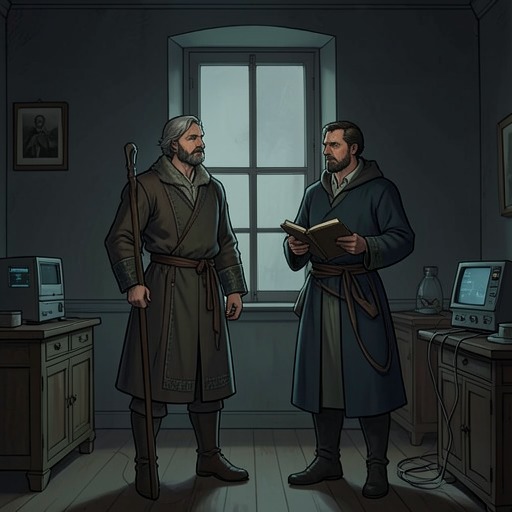
The summons made the boy turn pale. He hurried to the dormitory, set down his books, washed and combed his hair, then took his violin case and exercise book to the music rooms in an annex. A schoolmate directed him to wait in a practice room. No one called him; instead, the visitor entered himself. The Music Master shook hands with Knecht, confirmed his identity, remarked that the teacher was pleased with him, and invited him to make music together at the practice piano.
The purpose and meaning of the visit
The visit was neither accidental nor a routine inspection. Knecht’s name had already appeared on the list of pupils considered worthy of elite education, on the strength of teachers’ reports about his character, Latin, and especially his musical promise. The Music Master had stopped in Berolfingen during an official mission specifically to see him. The examination sought more than technical skill: it asked whether Knecht possessed the natural capacity for music in a higher sense, including enthusiasm, reverence, and the ability to subordinate himself in service.
Years later, Knecht described leaving the school to find the town and the world more enchanted than they would have been by any decorations or fireworks. For him, the meeting was a sacramental experience: the ideal world he had known only through hearsay and dreams had taken visible form. Its emissary had come not from a remote past or future but into the present, and the call had reached an apparently insignificant pupil in Berolfingen.
That inward revelation took weeks to connect with its practical cause. Knecht eventually understood that the experience was also an earthly act of favor and an exhortation from the educational authorities: his teachers had put him forward, and the Music Master had come to assess him. Berolfingen thus marks the point where a private sense of vocation and an institutional opportunity coincide. The town’s ordinary school setting makes the encounter’s force depend not on spectacle, but on the sudden presence of the world to which Knecht will be summoned.